
Back on Track

We have been trying to solve a recent recurring problem. The sail is not sliding up and down the mast as easily as it did when it was new. It doesnt hang up every time, and sometimes it is worse than others. We have always been able to get it up at least to the second reef point. Usually it just takes a little fiddling, letting it down a bit and re hoisting till it goes on up. It doesnt hang up coming down. The mast is about 45 feet long at the luff. It has a male track with a small amount of bend, and a joint in the track just below the Tangs, which is about 3/4 of the way up.The joint is kept in column by a spline that is screwed in with very short, small, metric, fine threaded, flathead screws. The question up to now has been whether the problem is with the track, the cars, the sail batten tension, the bearings, or something else.

This is the suspect car. If you move it from side to side with your hand, it moves a bit more than the others. This is the car that seems to be hanging up. We pulled the car and replaced the bearings. it still wiggles and it still hangs uo.

This is another view of the car in question. Note how it is out of alignment with the others. This was done by pulling it over by hand.

OK this is the track. This photo was taken aloft, right about where the thing seems to be hanging up. There is a scored place, a scratch on it, not in the side grooves, but on the face, The screws are in tight, and don’t seem to be protruding enough to catch on the car. The track is otherwise in alignment.

What we have done so far: gone up the mast and checked the joint in the track. It seems to be OK. It happens to be at the deepest point in the mast bend (It is bent fore and aft by tightening the diamond shrouds, which are swept back)

So, today we eased the diamonds about one thread on the turnbuckles.

This car is at the first batten which is a fiberglass rod, which is tensioned from the leech end with a big flathead screw. So today we backed off the tension on the batten till there was none.

The car bearings are torlon 1/4 inch. We removed the car, and replaced the bearings. I couldn’t tell any difference in the appearance. They all seem to be round without any flat spots or scoring.

To be continued.

HIGH SEAS AND YANKEE GUNBOATS

Roger Durham

https://www.amazon.com/gp/product/1570035725/ref=ppx_yo_dt_b_asin_title_o04_s00?ie=UTF8&psc=1

This is the fascinating story of a blockade run aboard the Canadian  S/V “Standard”.  Her 1862 voyage was from Halifax, Nova Scotia to Sapelo Sound, Georgia, and up the inland passage to the North Newport River, where her cargo of clothes, medicine and ammunition were off-loaded near Colonel’s Island at Melon Bluff. The much needed goods were then transported to, and eventually sold in Savannah.  The Brigantine was then scuttled in the river by her crew, as their escape was made impossible by the pursuit of the Union blockade steamers “Wamsutta” and the “Potomska”.  Author Roger Durham pieces the story together from different sources , most notably the very descriptive diary of James Dickson with his  accounts of the offshore perils, and observations of the wartime coastal conditons at Blackbeard and St Catherines Islands. The local home guard fired on the “Potomska” and  “Wamsutta”, as they descended the river at half moon bluff, mortally wounding two Union seamen. They were buried on Doboy Island. 

lesson 5. MORE On Tacking

Stolen from another blog, but good stuff.

>. When you begin the tack, throw
> the helm gently over. Don’t throw hard over. Sail thru the tack, as it were, make
> a big U-turn; as you begin the turn, sheet harder as you are essentially sailing
> closer to the wind. As you reach head-to-wind, let out the main, LEAVE THE JIB IN.
> The jib will help put you on the new tack. As the bows cross the eye of the wind,
> let the jib backwind and blow the bows on over to the new tack. Once across the

> wind, then cut the jib and sheet it first, on the new tack, then harden the main.

1,how fast you ‘throw’ your helm over, depends very much on wind & the boats
speed and the waves. The magic word is slow and as said before sail
your boat to the new tack.
2,Once on the new tack, don’t push hard upwind in the beginning,
get speed an then sheet in.
3,If you have missed (e.g. wind change during manouvere), do it like the old square riggers, reverse
tiller, sail backward to your new tack
4, In case you have a traveller rigged for you main sheet, you can
even sheet the main to windward and skip the jib backwinding job.

Spanish Florida Mission Period: A Reading List

Picking up where  the Fort Caroline Narratives  left off.

An archaeologists account of the discovery of the mission site Santa Catalina de Guale, its excavation and the artifacts they found there. Including several interesting photos.

AN EARLY FLORIDA ADVENTURE STORY

This one is a hair raising account of a 1595 shipwreck written by a Spaniard, Fray Andres de San Miguel.  He was bound for Spain aboard the ship “Our Lady of Mercy”, out of Havana. It foundered in the Gulf Stream with a broken rudder.  The remaining crew fashioned a makeshift lifeboat and drifted for several days until washing  ashore on probably either Little St Simons Island or Wolf Island. They were rescued by some local Guale Indians, who gave them maize cakes, acorn cakes and some water and a smoldering log. Then they were taken to Asao  (an indian settlement located on or very near the Fort King George site in modern- day Darien) , then  later on to San Pedro ( on Cumberland Island ) and eventually on  to St Augustine, Havana and Spain. There is a lot of original material here about the indians he encountered on the way back home , and on life in early St Augustine.  An eyebrow raising note:  Frey Andres mentions that he was shown the ruins of Ft .Caroline, then called Mateo, from the river, (probably  the St Marys or Cumberland river) as they were leaving San Pedro . San Pedro must have been very close to what is now the Dungeness ruins.

Father Ore’ was born in Peru but visited St Augustine and surrounding mission territory a few years after the Guale rebellion of 1597 (Juanillo’s revolt) His account was published in Spain around 1617. It is a brief  history of Spanish, English and the Catholic Church’s involvement in Spanish Florida up to that point. He recounts early explorations before the arrival of Pedro Menendez , the founder  of St Augustine, and subsequent explorations, settlements and missions along the coast as far north as the Chesapeake (Jacan ), as well as rebellions by the indians and the martyrdom of some of the religious.

A more in depth study of the  Spanish colonial support system Mainly concerned with Spanish Florida, From translated documents,  the author examines the relationships between the various native groups with St Augustine, and with the Catholic church.

Murder and Martyrdom is the story the deaths of five  Franciscan friars and the capture and ransom of another in Guale territory. The  Friars were clubbed to death  at the Guale Mission on  St .Catherines ‘Island,  and  at Tolomato,  located up around  Harris   Neck,   at  Tupiqui,  farther  inland  near Pine Harbor,  and  at  Asao,  near  modern-day  Darien.  The  book  is  full  of  information,  supported  with  maps  charts,  and translated  Spanish  documents.   

The Struggle for the Georgia Coast  is  the fruit of a long effort  by  Archaeologist  John Worth.  During  the  dispute  between  the English and Spanish  over  the  territory  between  Santa Elena (Parris  Island)  and  St  Augustine,  the  Englishman  James Edward Oglethorpe began colonizing and fortifying the coast,. The Spanish  King  Philip  V  ordered  governor Montiano,  in St  Augustine,  to gather  documentary  proof of  Spain’s  rightful  claim to  the  territory.  The  result  was a large  package  of  documents that  were   pulled  from  the  archives  at  St Augustine,  and  sent  to  Spain,  where  it all  languished  for a couple  of  centuries.  This is a  trove  of  information ,   which  included  royal  cedulas ,   maps,  tables,  census, registrys  and  correspondence.  John  Worth  translated  it  and puts  it all into  perspective. A more general introduction to the Spanish mission system within the ambit of St Augustine, along with descriptions of some of the  archaeologist’s and history scholar’s projects and  techniques. Many illustrations included.  According to Milanich, “Wally’s Leg”,  a creek that branches off the Macay river near the Frederica  river junction, is simply an English spelling of “Guale”.

Pedro de Quejo


Shot in the right front leg by a musket, this dog must have suffered greatly before succumbing to infection and being buried in a small grave in an indian village on the northern end of St Simons Island.
 

X-rays of the dogs legs reveal the damage done by the musket ball. Archaeologists believe  the dog was killed  by crew members of Pedro de Quejo, who was in the vicinity in advance of the 1526 Lucas Vasquez de Allyon expedition.- Jerald T. Milanich

Pedro de Quejo was an early Spanish explorer, trader and slaver in these parts, around the same time as Ponce de Leon’s voyages.  He was commissioned by Lucas Vasquez de Allyon to help find a suitable spot for a colony,  In 1526 Allyon left the Dominican Republic with six ships and about 600 men, women, friars, and cattle. They settled somewhere in this area, though the exact site hasn’t been positively identified.The colony didn’t last but a few months. Some scholars theorize that the colony, called San Miguel de Gualdape, was on Sapelo Island.

The above photos are from Jerald T Milanich’s book Laboring in the Fields of the Lord

A Brand New Daggerboard

The old starboard one broke clean into. I was wondering why the boat was handling so funny. Then one night at the dock, the bottom half just floated up next to the topside. Another “Maalox moment”.  It was a learning experience though. An autopsy showed that it had significant water intrusion into the balsa core right close to  the fulcrum point. Not good. When I did the layup, I thought I could seal the  heavy triax with a thickened resin as a flow coat. Those pinholes are hard to spot though, and it doesnt take but one. So the lesson is:  wet out a layer of light cloth first in the mold to help seal out the water! then do the layup.

The truth is,  the broken board took a few pretty hard whacks. One was in a lateral current up against a hard oyster bar. I think that one did it in.


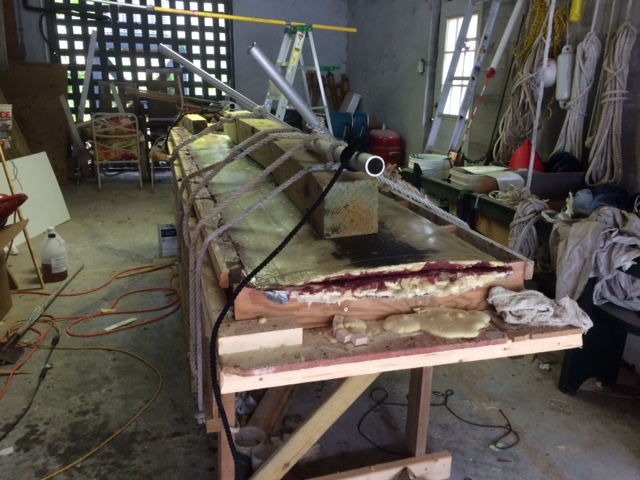
This is the female mold. It has to be dead nuts flat. I used some old truss joists for the table. This time I couldn’t find a formica sheet to use for the mold so I bought one of those PVC sheets and used that (to the left in photo). DONT do it! It isn’t rigid enough and the board will come out wavy. then you have to spend all this extra time fairing the thing.

Here are the two halves being squashed together. Weights and spanish windlass.  I am too cheap to make the whole thing up and then cut out the hole for the lifting block. It is more work though. I used an old lay-up leftover from my composite boat cleats, instead of a ss eyebolt. Pour in place, two part foam goes on the tip.


The Black stuff is graphite mixed in with some resin and phenolic microballons. Actually that goes down first on the mold, then the 6 oz cloth to seal the pinholes, then the triax etc. The graphite is supposed to lube the thing up so it won’t bind up so easy. I put in on there in case I have to sand it down a little bit if it is too big for the hole. It is hard to get it just right. My new crash block won’t fit that good either, this time. Once the oysters start growing inside the trunk It is a nightmare to get it clean enough for the crashbock to slide down to where it needs to be.